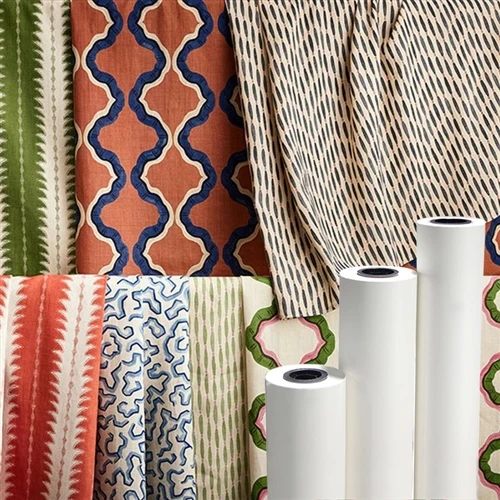
Yo! As a supplier of jumbo roll sublimation paper, I've seen firsthand how the surface finish of this paper can have a huge impact on the transfer process. So, I'm pumped to share some insights with you on how different surface finishes can affect the quality of your sublimation transfers.
First off, let's talk about what sublimation printing is. It's a process where heat and pressure are used to turn solid dye particles into a gas, which then bonds with a polyester or polymer-coated material. Jumbo roll sublimation paper plays a crucial role in this process, as it's the medium that holds the dye before it's transferred to the final product.
The surface finish of sublimation paper can vary, and each type has its own pros and cons when it comes to the transfer. One of the most common surface finishes is a smooth finish.

Smooth Surface Finish
A smooth surface finish on jumbo roll sublimation paper is known for its ability to produce sharp and detailed images. The smoothness allows the ink to spread evenly across the paper, resulting in crisp colors and fine lines. When you're printing high - resolution designs, like detailed photographs or intricate patterns, a smooth finish is often the go - to choice.
Take, for example, the 95gsm Jumbo Roll Sublimation Paper 95gsm Jumbo Roll Sublimation Paper. It typically has a smooth surface that can handle large - volume printing jobs. The smooth finish helps in minimizing any ink bleeding, which is super important when you want your images to look clean and professional. Since the ink sits on top of the smooth surface, it can be easily transferred to the final material during the sublimation process, creating a vivid and accurate representation of the original design.
However, there are some downsides to a smooth finish. Sometimes, it can be a bit more prone to static electricity, which might cause the paper to stick together during handling. Also, if you're using an ink that dries too slowly, there could be some smudging issues, especially in high - humidity environments.
Matte Surface Finish
Matte surface finishes on jumbo roll sublimation paper offer a different aesthetic. They're great for giving your prints a more subdued, professional look. The matte finish diffuses the light, reducing glare and making the colors look more natural and less saturated.
The 45gsm Jumbo Roll Sublimation Paper 45gsm Jumbo Roll Sublimation Paper with a matte finish is often used for applications where a soft - touch and non - reflective appearance are desired, such as for wall art or some types of fabric prints. The ink gets absorbed better into the slightly porous matte surface, which can enhance the color depth and make the image look more three - dimensional.
But, one drawback of matte finishes is that they might not be as good at reproducing very bright and vivid colors as a smooth finish. Also, the surface can be a bit more prone to showing fingerprints and smudges, which can be a problem if you're handling the paper a lot during the printing and transfer process.
Coated Surface Finish
Coated surface finishes are designed to improve the ink - holding capacity of the paper. These coatings can be either inorganic or organic, and they act like a reservoir for the dye. The coated surface allows for a higher density of ink to be applied to the paper, which in turn can lead to more vibrant and intense colors during the transfer.
The 100gsm Jumbo Roll Sublimation Paper 100gsm Jumbo Roll Sublimation Paper with a coated finish is often used for high - end applications where color accuracy and saturation are top priorities. The coating helps to prevent the ink from spreading too much on the paper, resulting in a more controlled transfer.
However, coated papers can be more expensive than non - coated ones. They also require a bit more careful handling, as the coating can be damaged if the paper is bent or creased. Plus, if the coating is not of good quality, it might not adhere well to the final material during the transfer, leading to uneven results.
Porous Surface Finish
Porous surface finishes are all about ink absorption. Papers with this type of finish have tiny pores that quickly soak up the ink, preventing it from pooling or running. This is especially useful when using fast - drying inks or when printing large areas of solid color.
The 35gsm Jumbo Roll Sublimation Paper 35gsm Jumbo Roll Sublimation Paper with a porous finish can work well for applications where quick drying is essential, like in large - scale production. The porous structure ensures that the ink is firmly held in place on the paper, which makes the transfer more reliable.
On the flip side, porous papers might not be the best for super - detailed designs. The pores can sometimes break up very fine lines, causing a slight loss of sharpness. And they can also be more susceptible to moisture, which could affect the ink storage and transfer quality.
Ultra - Thin Surface Finish
Ultra - thin surface finishes are found on papers like the 31gsm Jumbo Roll Sublimation Paper 31gsm Jumbo Roll Sublimation Paper. These papers are lightweight and flexible, which can be a great advantage in some applications. For example, when transferring to soft fabrics, an ultra - thin paper can conform better to the material's surface, resulting in a more seamless transfer.
However, ultra - thin papers can be a bit more difficult to handle. They're more likely to tear or crease, and they might not have as high of an ink - holding capacity as thicker papers. So, if you're printing very complex or ink - heavy designs, you might run into some issues.
In conclusion, the surface finish of jumbo roll sublimation paper has a significant impact on the transfer process. Whether you're looking for sharp details, vibrant colors, a soft - touch look, or quick drying, there's a surface finish that can meet your needs.
If you're in the market for jumbo roll sublimation paper and want to discuss which surface finish is best for your specific project, don't hesitate to reach out. We're here to help you make the right choice and ensure that your sublimation transfers turn out amazing.